
Texas Tech University Athletics
Texas Tech Volleyball: An International Affair
September 27, 2014 | Women's Volleyball
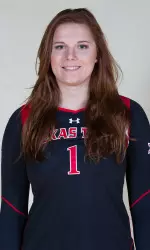
Emily Ruetter, Victoria Hinneburg and Audrey Fragniere discuss their experiences as international athletes in America.
Sept. 27, 2014
By: Blake Zimmerman
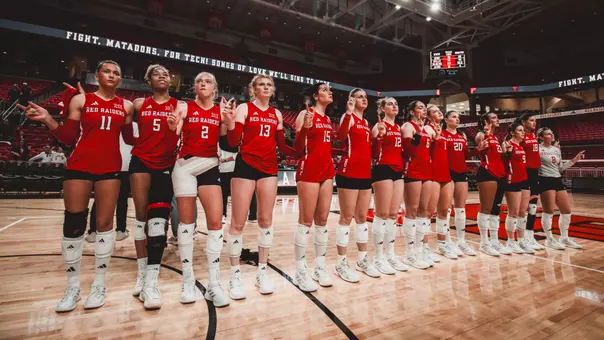
Just under 43 percent of the Texas Tech volleyball roster is made up of athletes not from the state of Texas.
Just over 14 percent of the roster is made up of players not from the United States of America.
That translates to three of the 21 players being from another country-- Emily Ruetter, Victoria Hinneburg and Audrey Fragniere.
Texas Tech head coach Don Flora said this is something that has been years in the making.
"Having the international experience being shared among our team from different parts of the world is awesome," Flora said. "There are different experiences and different ways to play volleyball, other than what we are used to here. Not only that, but Emily, Victoria and Audrey all have different experiences and bring different things to the table. Those different experiences help foster friendships among the team, which is a great thing."
Emily Ruetter, from Burlington, Ontario, was Flora's first international recruit. Flora said going to Canada was a natural transition into having more international players.
"Starting the international recruiting in Canada seemed like the most natural first step," Flora said. "The game there doesn't differ as much as it did with the other two, but there was still a learning curve for Emily, especially on the defensive end."
The thing Ruetter was most excited about in regards to playing in America was the emphasis on the student-athlete--something she was not used to at home.
"I love how student-athletes are treated in America," Ruetter said. "They are in a position where they can make an impact. In many cases, they are looked up to by children, which is awesome. I'm just not used to that kind of emphasis. It's nowhere near the same at home."
However, there are many things people don't realize about international athletes playing in America. Just not having a social security number can cause plenty of inconveniences.
"It's the little things," Ruetter said. "Like, for example, I couldn't activate my debit card over the phone the other day, because I don't have a social. Even the other day, I wanted to order something online, and since my debit card wasn't activated, I tried to use my Canadian bank account, but it wouldn't accept the billing address. Little inconveniences like that can be annoying."
Even with the small inconveniences, like always having to have international identification with her--Ruetter said American collegiate athletics are well worth it.
"We have big schools like this at home, but they don't value athletics like they do here," Ruetter said. "They can't give athletic scholarships in Canada. For a regular collegiate football game there, you would have a stadium that seats about 5,000 people. So, it was a big change to come here and see the facilities dedicated to athletics. I really like how athletes are treated here."
Ruetter has made the adjustment just fine, to the tune of already being No. 8 on Texas Tech's all-time career assist list.
Flora's first recruit from across the pond was Victoria Hinneburg, out of Leipzig, Germany. Hinneburg said there were scouts watching her matches overseas that convinced her to come play in America, and eventually, in Lubbock.
"I was at the German championships and I noticed a woman standing at a table with all kinds of flyers and a banner," Hinneburg said. "She was part of an organization that shows European volleyball players the benefits of playing in America. She was a European player who went to America and did it all herself, so this organization was a way for her to use her experience to help players adjust, too."
Hinneburg said there was more to her decision than just volleyball.
"I wanted to come to play in the U.S.A., so I could not only play volleyball, but also study," Hinneburg said. "In Europe, it's virtually impossible to do both."
When Hinneburg got to Lubbock, she immediately knew she was in the right place.
"It was really cool to see the campus and all the traditions they have at Tech," Hinneburg said. "I just fell in love with campus, the environment and the people here. It's a wonderful place to study and play volleyball."
Hinneburg was tabbed as the 2013 Big 12 Freshman of the Year, but battled injuries and was forced to redshirt. She finally got her first playing time as a Red Raider at the 2014 Lone Star Showdown, and registered a kill on her first swing. It was the culmination of a long journey back to the court. She took to social media that night with her excitement.
"What a great day to write history in my college experience and celebrate my comeback," Hinneburg wrote. "It took me long enough! Thank you to everyone who believed in me!"
It was the first of what is sure to be many from Hinneburg, as she already logged another kill in Tech's matchup with TCU a few days ago.
The third member of the trio is Audrey Fragniere, all the way from Neuchatel, Switzerland. It was one of Fragniere's Swiss teammates that brought up the idea of playing in America to her.
"I had a teammate tell me that she was going to come to the U.S.A., to play volleyball at a university, and I thought it was a great idea," Fragniere said. "The only problem was, I had just started playing volleyball and wasn't good enough yet, so I just forgot about it at the time. A couple years later, I was playing at the Swiss championships, and the same recruiter who helped my friend was there watching me. She asked me if I was interested in playing in America, and it went from there."
Like Ruetter and Hinneburg, it didn't take long for Fragniere to fall in love with Lubbock.
"When I first got here, I was able to imagine myself living here," Fragniere said. "I looked around and thought to myself, `I feel good here,' so it wasn't hard for me at all."
When asked what the hardest adjustment has been, Fragniere said there was one thing that wasn't difficult at all.
"Well, I can't say the food," Fragniere said. "Because I love the food here. When I was here for my official visit, we went to a steakhouse and it was great. Steak is probably my favorite food here.
When Fragniere did get to her most difficult adjustment, it was something one would expect.
"Just that I didn't know anyone at first," Fragniere said. "That was difficult, especially due to the fact that I don't have a car here and needed rides to places. However, I'm able to depend on my teammates. They've been like family to me here."
Fragniere showed flashes of major potential in practice, and then brought it to a game setting against Gardner-Webb a couple weeks ago. She recorded a career-high 13 kills on a hitting percentage of .579--the most accurate performance with that amount of kills from a Red Raider this season.
Flora said there are things the international recruits have to adjust to in regards to the American game, but they bring a lot to the table from the international game as well.
"I think for all of them, there has been an emphasis on blocking and defense since their arrival," Flora said. "Especially for Audrey and Victoria, and even for Emily--even though part of that with her just comes from being a setter--it's important to learn the importance of blocking defense, especially as a part of our system. The emphasis we put on that part of the game differs from what they are used to. They all have great offensive instincts, so we've really wanted to work with them on the defensive aspects."
Flora said when it comes to recruiting internationally, there are some obvious differences, but there are also some different things the coaches have to look for in the players as opposed to a normal American recruit.
"They have to be prepared to handle being so far from home," Flora said. "The level of homesickness is bound to be more than the average player on our team. I spend a lot of time talking with our staff about that--Are they ready to be on their own with new experiences, new food and new ways of living, among other things. I think that was a big piece of the puzzle in all three cases."
All three players agreed it isn't just the level of homesickness that increases, it's also the difficulty of traveling home that increases.
"This may be too obvious, but most people don't realize it takes me 24 hours to get home, "Hinneburg said. "If I left now, I would fly to Houston. From there, I would fly to Frankfurt and then on to Dresden. From Dresden, after flying all day, I drive an hour to get home, in Leipzig. So 24 hours after leaving, I'm finally in my bed."
It's a trip that Hinneburg's father and brother made this week, to see her play. They watched the Red Raiders sweep TCU, and they got to see her register a kill, as well.
It's trips like the one Hinneburg described that her, Ruetter and Fragniere, along with their families, will make over the coming years as part of their dream to play volleyball in the United States of America.