Texas Tech University Athletics
Master Of The Diamond
April 07, 2002 | Baseball
By Blayne Beal, Texas Tech Athletic Media Relations
The sleepy town of Dora, N.M. doesn't appear on many state maps and by most accounts the population is around 100, and that is if you count a six square-mile radius. Dora natives make their living through farming and ranching which can be a pretty tough trade year in and year out. But just down the street there is an escape that has bonded this small town for decades, the Dora High School Coyotes.
In 1962, the town of Dora was buzzing as a young baseball player named Larry Hays had guided their beloved Coyotes to the championship game of the New Mexico High School State Championships. Dora, N.M. had hit the big time.
"I remember playing in that state championship game and how excited everyone was to be there," said Nell Hays, wife of Texas Tech head coach Larry Hays. "Dora had been to the state basketball tournament that same year but had never been to the state championship in baseball. Larry and everyone else was so excited."
The Coyotes, however, found a better team in the State of New Mexico in that game as Jal High School defeated Dora to take home the state championship trophy. For just about all of the Coyote players, this was the end of the road when it came to baseball. Well, except for one.
L.D. and Pearl Hays made certain that their oldest son got an education and they figured he might as well play baseball while he was at it. Larry Hays began his college education at what was then Lubbock Christian Junior College where he lettered in both basketball and baseball and earned his Associate of Arts degree in 1964. After his days at LCU, Hays went back home to New Mexico where he earned both his bachelor's and master's degrees from Eastern New Mexico.
In 1968, Lubbock Christian head basketball coach Larry Rogers took a chance on Hays and offered him the assistant coaching job. Hays obliged and took the job despite the claim that he would never be a coach.
"I always said that I would never be a coach," says Hays. "When I was in high school I saw my coach get fired and I thought you had to be nuts to want to do something foolish like coaching."
As it turns out, Hays was pretty good at the craft and was soon approached by the Lubbock Christian administration to restart the baseball program that had been dropped soon after his departure in 1964. Once again, Hays agreed.
In 1971, Hays fielded his first team and a new era in Lubbock Christian athletics was underway. Despite everything weighing against him, Hays led LCU to a 28-16 record that season and over the course of the next 15 years the program suffered through just one losing season in 1981. Two years later, however, the losing season was completely forgotten as LCU captured its first NAIA National Championship in baseball in the NAIA World Series that had successfully been brought to Lubbock and LCU through Hays' leadership.
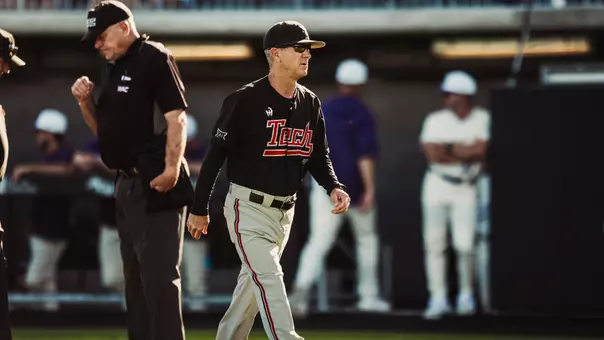
Three years after winning the National Championship at LCU, Hays and Texas Tech Athletic Director T. Jones began talks about Hays going across town to coach the Red Raiders.
"The funny thing about the whole deal was that I don't think T (Jones) was looking around for me and I sure wasn't looking around for him," said Hays. "One day we just found each other and he started trying to convince me to come coach at Texas Tech and I initially turned him down. Then two weeks later I read in the newspaper where I had agreed to take the job."
The move over to Texas Tech, despite how attractive it might sound, was not a move that either Hays or his wife Nell really wanted to take. Lubbock Christian was one of the finest baseball programs in the country and Texas Tech's program was one of the most forgotten in the country. In fact, Texas Tech didn't even have a winning record as the Red Raiders had accumulated a mark of 544-572-6 up until that point.
"When Larry took the job at Texas Tech I was completely against it," said Nell Hays. "Both of us cried and cried because we realized we were saying goodbye to a program that he had started. It was just like leaving one of your babies behind."
So what was it that convinced Hays to take the chance on Texas Tech? Why would anyone come to a program that had a terrible facility and virtually no support from university administration? The answer was simple. T. Jones.
"T. Jones told me that he thought Texas Tech could really have a good baseball program if we made a lot of changes," remembers Hays. "He promised me that there would be financial support from the administration and that I would have his full cooperation. I wasn't bored at LCU but I was ready for a new challenge and I thought Texas Tech was the perfect place to challenge me."
Hays immediately began working to make the Red Raiders a competitive team both on and off the field and that took a large amount of effort from himself, the university and his family. He fielded his first team in 1987 and suffered through just his second and last losing season as the team went 21-28 leaving both Hays and the Red Raiders with plenty of room for improvement.
One of Hays' biggest obstacles was to change the perception that people had of Tech baseball not only in Lubbock but also around the state. Hays is infamous for his stories from his early days of recruiting at Texas Tech and he will be the first to tell you that it was not easy.
"I have told this story a 100 times but it is 100 times true," said Hays. "We had it figured out that you could make the turn out by our ball park at about 45 mph and we would put recruits in between two of our biggest guys in the back seat of the car. We would drive right by the stadium and yell out 'and that's our field' and then I would punch the gas hoping they never really got a good look at it."
Through the efforts of athletic directors T. Jones, Bob Bockrath and Gerald Myers the Texas Tech baseball program has grown into one of the finest baseball programs in the country. In 1988, local businessman Dan Law became the first major contributor to the program as he organized an effort to put in the current lighting system that is still one of the finest in the nation. That same season, Texas Tech renamed the baseball stadium to Dan Law Field honoring Law's efforts toward the baseball program.
Hays said that in order for the Texas Tech program to be successful they must do an outstanding job with the facilities and in recruiting (which he calls not only getting players but getting top notch uniforms, travel accommodations etc.). Dan Law Field has undergone miraculous improvements over the years and has grown into one of the better ballparks in the state. With the help of former Tech Board of Regent Jim Sowell, Dan Law Field just completed Phase One of renovations that included a new major league clubhouse, a new outfield wall, an interior brick fa?ade and a new exterior fence. And more is on the way in the near future as plans call for an exterior fa?ade, a new press box and a roof awning.
"Jim Sowell has been the biggest single push for this program," says Hays. "I think it would be a mistake to just include baseball because he has supported our entire athletic program here at Tech."
As Hays started to get the Tech program on the move in the early nineties, the NCAA handed him and the rest of college baseball coaches a blow when they reduced scholarships to the current amount of 11.7 per team. Hays was left to wonder how he could convince athletes to come to school with next to nothing in scholarship money.
"Up until the NCAA scholarship cut, I had always been a high school guy because I believed in getting guys and having them around for four years," said Hays "But when the NCAA changed the rules we really felt that we couldn't risk offering so many scholarships to high school kids if we wanted to be competitive every year. Don't get me wrong I still want high school kids and I always will but sometimes you have to fill immediate holes and so far we have been lucky in doing that."
In 1995, Hays captured his first conference title (Southwest Conference) at Texas Tech and set a school record for wins in a single season as the team went 51-14 and fell just one game short of the College World Series. Since then, Hays and his Red Raiders have not missed an NCAA Tournament as the Red Raiders currently hold the longest active streak of consecutive NCAA Tournament appearances among schools in the Big 12 Conference.
In 1997, Hays guided Texas Tech to the inaugural Big 12 Championship and then took home the Big 12 Conference Tournament Championship in 1998. The Big 12 Tournament championship of 1998, unfortunately, was not the biggest news of that year for the Tech baseball program. The Texas Tech Athletic Department learned that year that the NCAA had put the school on probation for four seasons cutting numerous scholarships including three for baseball. The school was put on probation for compliance mistakes forcing Hays to get a new look for his squad.
Despite having three fewer scholarships than everyone else in the country, Hays' teams have yet to miss an NCAA Tournament and finished second in the Big 12 last season. Pretty remarkable considering the stigma that has been placed on the department after those allegations surfaced.
Hays is currently the fourth winningest active head coach in the nation and the sixth winningest baseball coach in the history of NCAA baseball. But despite all of his successes, the Red Raiders have been unable to make it to the College World Series which is something Hays hopes to accomplish in the near future.
"Since this scholarship reduction we have been hurt with numbers and now this being our last year we are finally getting over it. I want us to raise our standards to where every year we are expected to be in Omaha."
The 10th man in Hays lineup has always been his wife Nell as the two have been married for 37 years and are the proud parents of five children and the grandparents of nine. The family atmosphere that Hays and his wife bring to the Texas Tech program is truly unique. Hays' oldest son Daren currently serves as the team hitting coach and just like his father was the head coach at LCU before coming to Tech in 2000.
It is not unusual to see Hays talking to his grandchildren from his position over at third base as they flock down the left field bleachers to see granddad. Most people would view Hays as being distracted but it is quite the opposite. Hays has always paid attention to the things in life that are truly important such as his family, his church and his players and in return that has led to success on the baseball diamond.
"I am really proud of what he has been able to do in his career," said his wife Nell. "He has been so good to me and to his kids and grandkids. Texas Tech has really been a joy in our lives and we have had a lot of fun playing in the Southwest Conference and in the Big 12. Obviously, Larry's ultimate goal is to play in and win the National Championship and hopefully someday he will get that opportunity."
The small town roots of Dora, N.M. have never left Hays as he is one of the most highly regarded individuals in the City of Lubbock and in all of coaching. His gentle nature and compassion for people have earned him the respect of former players, co-workers, family and friends. Although Jal High School prevailed in that state championship game back in 1962, the community of Dora has always been proud of Larry Hays. Their native son is a champion on the baseball diamond but most importantly he is a champion in life.