
Texas Tech University Athletics
A Look Back At The History Of Tech Baseball
March 30, 2002 | Baseball
By Chris Snead, Texas Tech Alumni Association
The story of Texas Tech baseball begins quite harmlessly in 1926, during the spring of the first academic year at Texas Tech. E.Y Freeland, Texas Tech's first baseball coach, worked diligently to produce a winner on the plains and it seemed that his diligence paid off with the first team producing a more than respectable record of 10 wins, two losses and a tie. The names are not the ones that you would know, but they were the foundation for a program that seemed to be on the right path. Names like Kaufman, Rigney, and Peterson, Burnett, De Witt, and Edelmon led the way for Tech baseball in the early days.
The most notable Texas Tech baseballers from the early period may have been Raymond Marshall and Alvin "Iron Man" Waller. Marshall, the first true power hitter for Tech and Waller, the first great pitcher took the reigns of the young Texas Tech squad and led Coach Freeland's band of ballplayers to early success. Texas Tech enjoyed great success in 1926, however, the 1927 season, E.Y. Freeland's final season as Tech head coach, the Matadors fell back to the pack producing a 4-9-1 record.
After two years under Grady Higganbothan as coach and a combined 10-17 record in those seasons, baseball was dropped as a varsity sport at Texas Tech. There had been a concerted effort to make baseball successful in the early years at Tech but as was the case in many locations around the country at the time, it was hard to generate enthusiasm for this sport played on this level. As much as it pained the members of the Texas Tech athletic council and Amon G. Carter, the chairman of the Tech Board of Directors, and a huge fan of baseball, baseball had to be eliminated.
It was not until the 1954 season that baseball was revived as a varsity sport at Texas Tech thanks to the recommendations of Head Football DeWitt Weaver, who carried a lot of clout given that he had just come off of a 11-1 football campaign that included a whipping of Tennessee in the 1953 Gator Bowl. Beattie Feathers was selected to take the reigns of a program that had been dormant for some 25 seasons and predictably got off to a rough start with a 1-7-1 campaign. Familiar names dotted the lineup such as Wick Alexander and Norman Huggins but they could not get over the hump in the first year back. The Raiders also competed in the Border Conference, one that they had great success in Football and basketball, however, the baseball conference had been dominated by the University of Arizona Wildcats, who won every conference championship of the Border Conference's existence. After a slow start, the return of Tech baseball went through a series of up and down seasons that netted a 41-56-1 record in the seven seasons of baseball under Feathers. Berl Huffman took over the program and led Tech to an 80-88 record in his seven seasons as Texas Tech skipper.
Texas Tech entered the southwest conference in 1968 with a new coach in Kal Segrist and a new attitude, however, the competition had improved significantly. Tech traded the likes of New Mexico St. and Colorado State for the baseball powerhouses of Texas Christian and the University of Texas. Tech's first full season in the SWC garnered a putrid 2-15 record and 7th place finish in its new conference affiliation. Coach Segrist began to build a program on the South Plains and the made the Red Raiders a legitimate contender in the SWC. Tech enjoyed consistent success unparalleled by any other segment of Tech baseball history to this point going. In 1971, the Raiders burst onto the SWC scene and made a statement with an 11-7 conference record that earned them a third place finish in a very competitive league. This team, arguably, Segrists' best in his 15 seasons, compiled a 26-14 record. This squad had a terrific core of Tech stars lead by Doug Ault, Johnny Owens and Tech hurler Ruben Garcia. Laying the foundation for future success, Tech had established itself as a player in the SWC.
The 1987 season opened a new door to Texas Tech baseball. Texas Tech lured NAIA championship coach Larry Hays from cross-town rival Lubbock Christian College. Hays came to Lubbock with an impressive resume, close to 1000 wins, countless NAIA post-season appearances, a slew of players advancing to professional baseball, and a National Championship in 1983 to put a cherry on top.
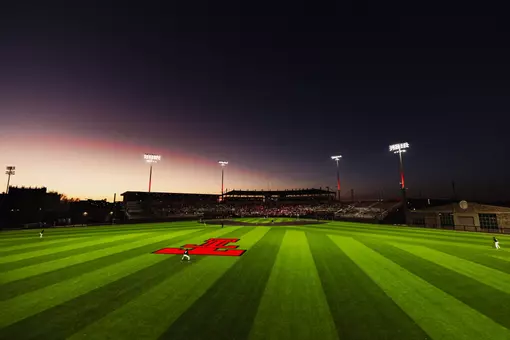
The addition of Hays was just the beginning of a new era of baseball at Tech. The 1988 season brought night baseball to Texas Tech when Tech letterman and athletic council member, Dan Law, helped to make night games a reality with the donation of lights to the Tech diamond. In honor of his donation, the name of the Tech diamond was changed to what it is now Dan Law Field. Larry Hays also brought another when Astroturf was brought in to cover the infield. This paid immediate dividends. The windy and dry climate in Lubbock made it tough to grow a suitable infield. The time and money that it took to grow a quality, division I type grass infield was beyond the reach of the program that was basically surviving on a shoestring budget and minimal donations. Astroturf in the infield immediately made Tech a better fielding team. It also allowed Tech to compete with the University of Texas, who at the time was the only other team to play on turf.
Hays' teams languished in the late '80s, struggling to complete in the tough SWC, players like Mike Gustafson, Mike Humphries and Brian Christiansen worked hard to keep their heads above water. Tech produced records of 21-28 in 1987 and 34-25-1 in 1988 before a 33-22 campaign in 1989 when Tech tied for fourth, its highest finish since 1980. The 1990's brought continued success for the Red Raiders, the records continued to improve and the talent level also increased. In 1991 Tech broke the 40-win plateau for the first time in school history. This was a feat that would be achieved eight more times in the '90s. Only the 1992 season in which the SWC decided to use a double round robin format for the regular season, in which each team would play a home and away series against every conference opponent. This one-year experiment failed miserably as the SWC teams beat up on each other and kept many good teams from advancing to post-season play, including the Red Raiders. The '90s also brought Tech its first national rankings when Baseball America placed the Red Raiders in its polls from April 1 to April 15.
The '90s provided Tech with its first-ever successful SWC Tournament appearance, when in 1994, Texas Tech won its first ever tournament game, defeating the Rice Owls 12-11. Texas Tech followed that appearance with a regular season and tournament championship in the SWC. That team, behind six All Americans in Clint Bryant, Jason Totman, Randy Duross, Brandon Welch, Dion Ruecker, and Matt Miller, won a school record 51 games and led the nation in batting average. That team also achieved the school's first ever NCAA tournament appearance when it accepted the number one seed in the Midwest Regional in Wichita, Kansas. It came within one strike of going to Omaha and the College World Series before falling to Stanford University in the championship game of the regional and finished the season ranked in the top 10 nationally.
The 1996 team finished second in the SWC tournament, the final year of the SWC. The 1996 season saw Tech finish second in the SWC tournament, the final SWC event, and hosted its first ever regional at home that ended in a loss to Southern Cal in what many believe to be the best game played at Tech in the school's history. Tech roared into the newly formed Big 12 conference going 23-7 in a conference that had perennial powers Oklahoma State, Oklahoma, Texas and Texas A&M. Tech won the regular season and lost the championship of the Big 12 in a slugfest with OU, 19-17. The 1998 team won the Big 12 tournament in grand fashion under the leadership of Keith Ginter, who had returned for his senior season. The Red Raiders took its squad to the Atlantic Regional in Miami and battled valiantly to the bitter end, which was a 13-0 loss to Miami.
Texas Tech and Hays have been able to raise the level of talent and expectation at Texas Tech. Each season brings a renewed spirit and excitement that other college baseball rich areas have long enjoyed. Texas Tech has caught and passed many of the former SWC foes that regularly kicked the Red Raiders around in the past. Texas Tech has been to the NCAA tournament each year since 1995 and is regularly ranked in one of the four major polls. Many milestones have been achieved here at Tech. Tech fans have been treated to the likes of Hays 1000th, 1100th, and 1200th wins, and perhaps by the time of printing, they will have enjoyed his 1300th career win, which puts coach Hays in company with some exquisite names. And speaking of fans, Texas Tech may have among the best and most knowledgeable in the country, if I do say so myself.
The past is rich and the future is bright. There have been bumps and bright lights along this journey. The story of Texas Tech baseball is too much to condense into a couple of pages, there are so many names and so many stories to tell. I hope that I have been able to perhaps tell you something that you did not know about this program. In looking at the state of baseball at Texas Tech, it's safe to say that Amon G. Carter may have gotten his wish...